search
WELCOME TO SOUNDENGG
Precision Engineering Toolkit
search
ENGINEERING TOOLS
|
Delay Calculator
|
Phase Alignment Node
Delay Calculator
Phase Alignment & Acoustic Propagation
SYSTEM_CALIBRATED
DELAY OFFSET
ACOUSTIC LATENCY CALC
2.91ms
Propagation Progress (0 - 50ms)
0.0%
school
expand_more
Engineering Insight: Sound Physics
Sound travels through air at approximately 344 metres per second (1,128 ft/s) at 21°C. However, this speed isn't constant; it is primarily affected by temperature. As air gets warmer, molecules move faster, and sound propagation speed increases. For every degree Celsius increase, sound speed increases by about 0.6 m/s.
In professional sound reinforcement, Time Alignment is critical. When using "delay towers" at a large festival, the sound from the main stage speakers takes time to reach the back of the crowd. If the delay speakers fired at the same time as the mains, the audience would hear a "double hit" or echo.
By delaying the secondary speakers to match the arrival time of the primary sound wave, we maintain phase coherency and professional clarity across the entire venue.
inventory_2
SPONSOR SPACE (PENDING)
|
Pinout Reference
|
Hardware Wiring & Interfaces // 0 CONNECTORS
search
AUTHOR IDENTITY
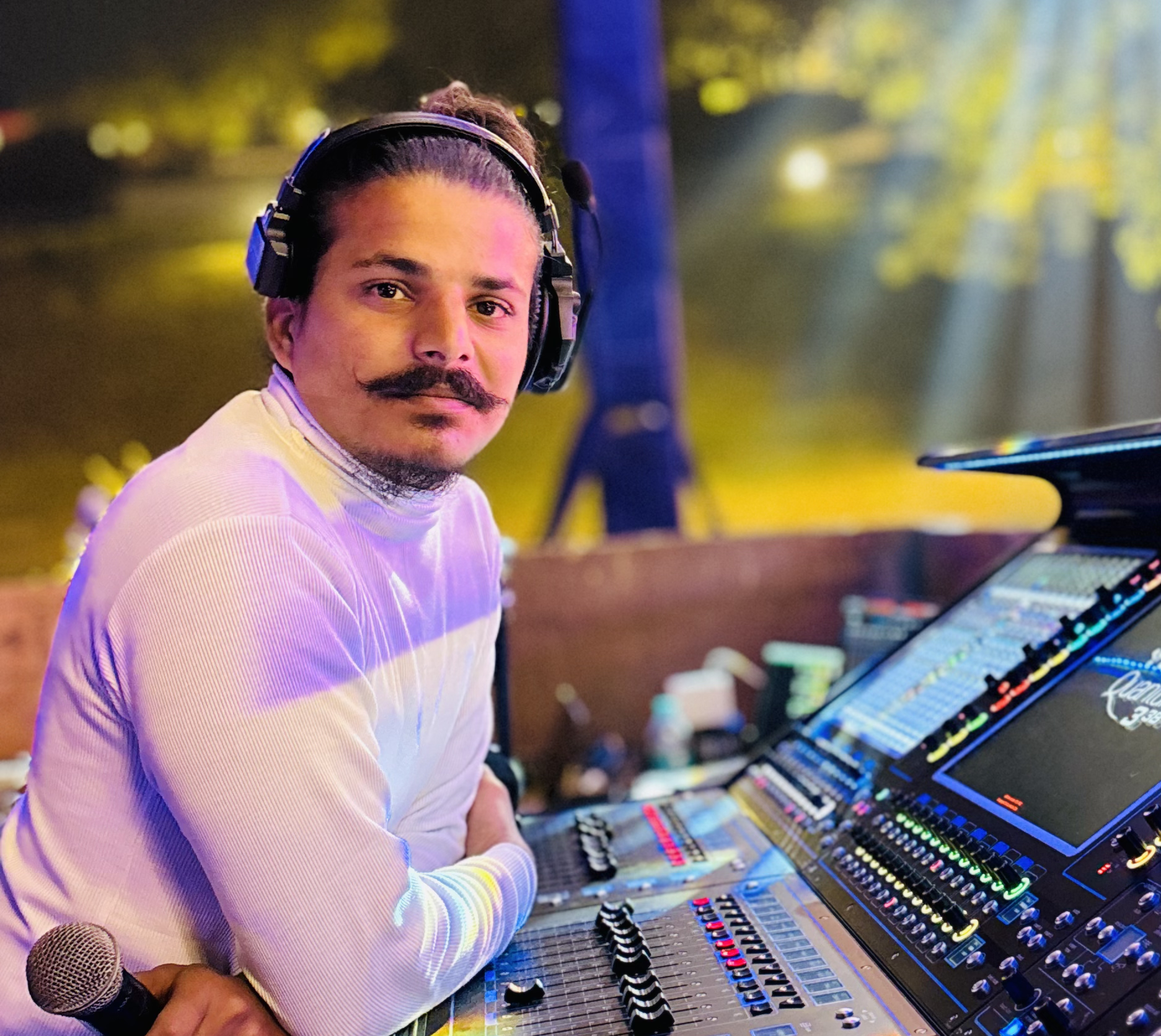
Sujan Subedi // Live Sound & System Engineer
SUJAN SUBEDI
Distinguished Live Sound Mixing & System Engineer
Sujan Subedi is a distinguished Live Sound Mixing and System engineer in Nepal and India. He started the journey in Live Sound from 2019 as a tech and kept upgrading himself in this field. Later in 2021 he joined the Sound Engineering Diploma classes in KMMC college in Chennai, India, a college established by an Oscar winner A.R. Rahman.
After his completion of diploma he started working in a Sound rental company in Mumbai, Goa, Banglore and recently in Udaipur. Started with the EV systems, later he kept working with d&b audiotechnik, RCF, JBL, and audiofocus systems.
Core Services
- check_circle System Design: Tailored audio configurations scaling from clubs to stadiums (d&b, RCF, JBL).
- check_circle Live Band Mixing: FOH & Monitor engineering for high-profile touring acts.
- check_circle RF Coordination: Wireless microphone and IEM spectrum management in dense RF environments.
- check_circle Corporate AV: Specialized setups for summits (G20) and product launches (Mahindra, Audi, Dell).
Portfolio & Experience
Featured Engineering Operations
festival Concerts & Festivals
Sunburn Festival, India Bike Week, DGTL Festival.
corporate_fare Global & Corporate Events
High profile Government Conferences like G20 meet, product launches for OLA, Mahindra, Audi, Lamborghini, and yearly meets of MNCs like Dell Technologies, Sennheiser, Deloitte, Axis Bank, and more.
person_play Featured Artists
Kailash Kher
Hargun Kaur
Salim Suleiman
B Praak
Sonu Nigam
Harshdeep Kaur
Madhur Sharma
Twin Strings
Usha Uthup
Papon
Sukhwinder Singh
Live Mixing Action
Festival Setup
System Design
FOH Console
Contact Us
Reach out for live sound engineering, system design, or wireless management for your next event.
Contact Details
Direct Support
mail sujan@soundengg.com
support_agent
Direct Response Console
|
Privacy Policy
|
Data & Microphone Security
info 1. Information Collection
At SoundEngg, we prioritize the privacy of our visitors and audio technicians. We collect minimal information strictly necessary to deliver a seamless audio engineering workspace:
- Account Information: When you register via Supabase / Apple Sign-In, we securely store your email address and profile preferences to synchronize active toolkit setups and custom presets.
- System Diagnostics: Following standard technical procedures, we log anonymous diagnostic metrics to continuously test and calibrate DSP math.
mic 2. Real-Time Audio & Microphone Processing
SoundEngg requests device microphone access (utilizing the RECORD_AUDIO / iOS Microphone permission) purely to perform ephemeral mathematical calculations locally on your hardware:
- Fast Fourier Transform (FFT): Computes real-time 31-band and high-resolution spectral distributions for the Real-Time Analyzer (RTA).
- Peak & Fundamental Frequency Detection: Identifies live room resonances and feedback frequencies.
Zero Audio Storage Guarantee: Zero audio data is recorded, saved, cached, or transmitted to any server. Audio buffers exist only in volatile RAM for milliseconds and are discarded immediately after calculation.
ads_click 3. Google AdMob & Privacy Controls
SoundEngg serves non-disruptive advertisements using Google AdMob. On mobile devices, standard anonymous advertising identifiers (Apple IDFA or Google AAID) are handled strictly in accordance with App Store & Google Play privacy policies.
You can upgrade to SoundEngg Pro at any time to permanently remove all advertisements and unlock unrestricted offline functionality.
security 4. Enterprise-Grade Data Security
Authentication is securely routed through Supabase with end-to-end TLS encryption. Passwords and credentials are never stored in raw plaintext.
delete_forever 5. User Data Deletion Rights
You can permanently delete your account and all associated profile configs at any time using the in-app "Delete My Account" button located in the Preferences tab, or by emailing legal@soundengg.com.
|
Terms of Service
|
User Agreements & Safety
gavel 1. Agreement to Terms
By accessing the Titan Console application, you agree to be bound by these Terms of Service. These terms apply to all audio engineers, technicians, and system designers deploying our utilities.
warning 2. Engineering & Safety Disclaimer
CRITICAL NOTICE: All calculators, delay alignments, cardioid subwoofer spacing formulas, and measurement tools are designed as precision advisory aids. Live sound reinforcement involves extreme acoustic and high-voltage electrical energy.
Always verify theoretical calculations against physical laser distance meters and verified manufacturer guidelines before driving high-voltage amplifier channels.
copyright 3. Intellectual Property Rights
All DSP algorithms, interactive schematic generators, acoustic delay matrices, and application logic are the proprietary intellectual property of SoundEngg.
verified 4. Pro Subscriptions & Guarantee
SoundEngg Pro is available as Monthly, Yearly, and Lifetime licenses. In-app purchases are securely processed through Apple App Store (In-App Purchases) on iOS and Google Play Billing on Android.
For web purchases, we provide a 7-day money-back guarantee via support@soundengg.com.
contact_support 5. Further Assistance
If you have any questions regarding usage terms, licensing, or corporate deployment, please contact our engineering support team at support@soundengg.com.
SETTINGS
|
Audio Routing, Preferences & Appearance
Audio Routing
Measurement Input
Audio Output
warning
Safari Routing Notice
Programmatic output selection is not supported in Safari/macOS. Audio will always play from your system default speaker. Please change your output device using the macOS Control Center or System Settings.
Global Preferences
Default Unit System
Appearance
dark_mode Theme Mode
palette Theme Accent
|
Signal Generator
|
Acoustic Calibration & System Line-Check
Output Console
STATUS: STANDBY
METER_LEVEL
-∞ dB
GAIN
-18 dB
0
-6
-12
-18
-30
-60
Frequency Selection
Hz
Waveform Generator
Frequency Sweep Generator
expand_moreDURATION
Operational Notes & Safety
expand_more- info Pink Noise is calibrated for constant energy per octave (RTA Calibration).
- warning Start at -18 dB to prevent accidental transducer damage.
- bolt Soft-start logic is enabled to prevent DC clicks.
ENGINEERING BLOG
Technical Deep Dives // SoundEngg Knowledge Base
|
RTA Spectrum Analyzer
|
31-Band ISO RTA
PEAK LEVEL
-∞ dB
DOMINANT FREQ
--- Hz
Analysis Setup
Pink Noise Source
Display Mode
Frequency Weighting
Calibration & Settings
Averaging
4
Calibration Offset
100 dB
Mic Calibration
Peak Hold
Snapshot Bank
|
Ear Training
|
Spectral Identification & Accuracy
Configuration
expand_more
TRAINING MODE
TIER
SOURCE
CUSTOM TRACK
No track loaded
0:00
0:00
BOOST
Listen to A (Dry) and B (Processed). Identify the boosted frequency.
Frequency Bands
SELECT BAND
1. Guess Action Direction
Click Play to begin challenge
SESSION
0
QUESTION
0/10
SCORE
0%
|
Impedance & Power
|
Speaker Load Calculator
Wiring Connection Mode
Speaker Specifications
W
Amplifier Specifications
W
Live Calculation Results
Total System Load
4.00 Ω
Total Delivered Power
2000 W
(1000 W per speaker)
info
Calculating Setup...
|
Sub Array Calculator
|
Sub Array Alignment
Calculator Setup
Target Frequency
Hz
Temperature
°C
Speed of Sound
343.4 m/s
Wavelength at 100 HZ
⅛ λ
0.429
m
⅙ λ
0.572
m
¼ λ
0.859
m
⅓ λ
1.145
m
½ λ
1.717
m
λ
3.434
m
Array Configurations
Cardioid (Gradient)
Horizontal deployment. Rear sub inverted + delayed by ¼λ travel time.
Cabinet Depth
m
Spacing
0.859 m
Delay
2.5 ms
Polarity
INVERT REAR
End-Fire Array
Subs in-line front-to-back, progressively delayed by ¼λ travel time.
Spacing (¼λ)
0.859 m
Progressive Delay
2.5 ms
Broadside Array (Max Spacing)
Subs side-by-side. Spacing must not exceed ⅔λ to avoid side-lobes.
½λ Max Spacing
1.717 m
⅔λ Absolute Limit
2.289 m
school
expand_more
Engineering Insight: Subwoofer Array Physics
Subwoofers produce very long wavelengths — a 60Hz tone has a wavelength of approximately 5.72 metres (18.75 ft). Because standard speaker cabinets are much smaller than this wavelength, a single subwoofer radiates energy nearly omnidirectionally at low frequencies. This means bass energy goes everywhere equally — towards the audience, behind the stage, into the building structure, and towards performers.
Array techniques exploit acoustic interference to shape this otherwise uncontrollable pattern. By spacing multiple subwoofers apart at specific fractions of a wavelength (typically λ/4), you can create a cardioid (heart-shaped) pattern that produces significantly more bass energy towards the audience while cancelling energy behind the array by 10–20dB. This dramatically reduces stage wash, monitor bleed, and structural loading on the venue.
Gradient arrays use a rear-facing subwoofer delayed by 1/4 wavelength. End-fire arrays use front-to-back spacing equal to 1/4 wavelength with delay on the rear cabinets. Broadside arrays use vertical stacking to increase gain at long throw distances without changing the horizontal directional pattern.
|
Tap Delay
|
BPM & Multi-Subdivision Milliseconds
BEATS PER MINUTE
---
BPM
TAP BUTTON TO START CALCULATING
Calculated Delay Subdivisions
Double Delay (2x / Half Note)
--- ms
Single Delay (1x / Quarter Note)
--- ms
Half Delay (1/2 / Eighth Note)
--- ms
Quarter Delay (1/4 / Sixteenth Note)
--- ms
Eighth Delay (1/8 / Thirty-second Note)
--- ms
PREFERENCES
|
Account, Appearance & Credentials
Account Details
mail Email Address
user@example.com
workspace_premium Subscription Pass
FREE TIER
calendar_month Next Renewal
N/A
Sign in to back up your custom presets, unlock mic calibration curves, and sync subscription across platforms.
Information
Sign Out
Danger Zone