WELCOME TO SOUNDENGG
Precision Engineering Toolkit
TIME DELAY ANALYSIS
Precision Phase Alignment Node // CALIBRATION_ACTIVE
Delay Calculator
Phase Alignment & Acoustic Propagation
DELAY_OFFSET:
2.91ms
school
Engineering Insight: The Physics of Sound Delay
Sound travels through air at approximately 344 metres per second (1,128 ft/s) at 21°C. However, this speed isn't constant; it is primarily affected by temperature. As air gets warmer, molecules move faster, and sound propagation speed increases. For every degree Celsius increase, sound speed increases by about 0.6 m/s.
In professional sound reinforcement, Time Alignment is critical. When using "delay towers" at a large festival, the sound from the main stage speakers takes time to reach the back of the crowd. If the delay speakers fired at the same time as the mains, the audience would hear a "double hit" or echo. By delaying the secondary speakers to match the arrival time of the primary sound wave, we maintain phase coherency and professional clarity across the entire venue.
inventory_2
SPONSOR SPACE (PENDING)
PINOUT REFERENCE
Hardware Wiring & Interfaces // 0 CONNECTORS
search
AUTHOR IDENTITY
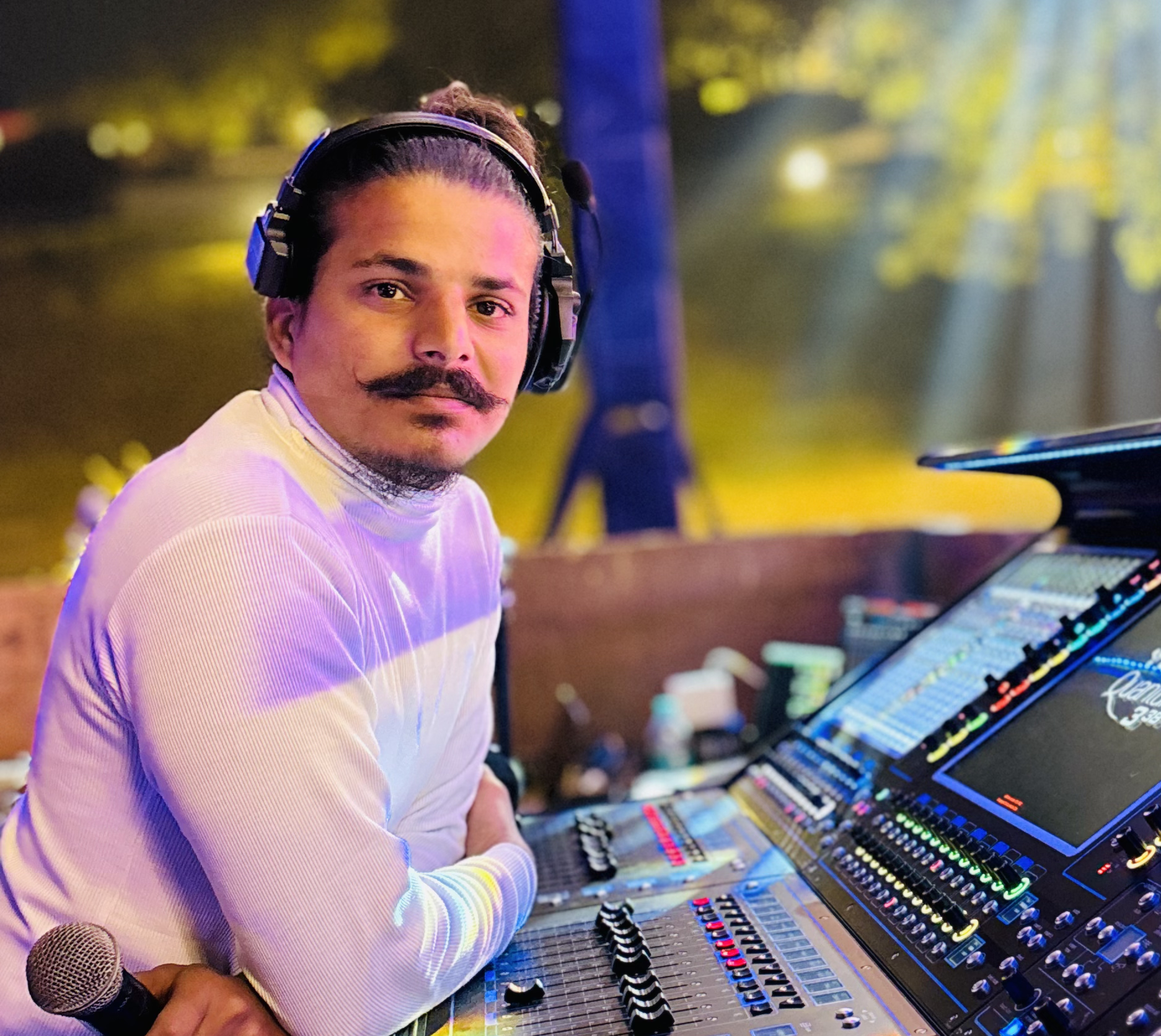
Sujan Subedi // Live Sound & System Engineer
SUJAN SUBEDI
Distinguished Live Sound Mixing & System Engineer
Sujan Subedi is a distinguished Live Sound Mixing and System engineer in Nepal and India. He started the journey in Live Sound from 2019 as a tech and kept upgrading himself in this field. Later in 2021 he joined the Sound Engineering Diploma classes in KMMC college in Chennai, India, a college established by an Oscar winner A.R. Rahman.
After his completion of diploma he started working in a Sound rental company in Mumbai, Goa, Banglore and recently in Udaipur. Started with the EV systems, later he kept working with d&b audiotechnik, RCF, JBL, and audiofocus systems.
Core Services
- check_circle System Design: Tailored audio configurations scaling from clubs to stadiums (d&b, RCF, JBL).
- check_circle Live Band Mixing: FOH & Monitor engineering for high-profile touring acts.
- check_circle RF Coordination: Wireless microphone and IEM spectrum management in dense RF environments.
- check_circle Corporate AV: Specialized setups for summits (G20) and product launches (Mahindra, Audi, Dell).
Portfolio & Experience
Featured Engineering Operations
festival Concerts & Festivals
Sunburn Festival, India Bike Week, DGTL Festival.
corporate_fare Global & Corporate Events
High profile Government Conferences like G20 meet, product launches for OLA, Mahindra, Audi, Lamborghini, and yearly meets of MNCs like Dell Technologies, Sennheiser, Deloitte, Axis Bank, and more.
person_play Featured Artists
Kailash Kher
Hargun Kaur
Salim Suleiman
B Praak
Sonu Nigam
Harshdeep Kaur
Madhur Sharma
Twin Strings
Usha Uthup
Papon
Sukhwinder Singh
Live Mixing Action
Festival Setup
System Design
FOH Console
Contact Us
Reach out for live sound engineering, system design, or wireless management for your next event.
Location & Details
Location
455, Main Rd, Jai Shree Colony,
Ganapati Nagar, Udaipur,
Rajasthan 313001
Direct Contact
mail sujan@soundengg.com
location_on
Udaipur, Rajasthan
SYSTEM SETTINGS
Audio Routing
warning
Safari Routing Notice
Programmatic output selection is not supported in Safari/macOS. Audio will always play from your system default speaker. Please change your output device using the macOS Control Center or System Settings.
Global Preferences
Appearance (Pro)
SIGNAL GENERATOR CORE
Acoustic Calibration & System Line-Check
STATUS: STANDBY
OUTPUT_LEVEL
-∞ dB
FREQUENCY_HERTZ
Hz
SEC DURATION
WAVEFORM_TYPE
MASTER_GAIN
-18 dB
ENGINEERING BLOG
Technical Deep Dives // SoundEngg Knowledge Base
SPECTRUM ANALYZER PRO
Real-time Acoustic Analysis // 31-Band ISO RTA
PINK NOISE
MODE
WEIGHT
AVERAGING: 4
CALIBRATION: 100dB
MIC CALIBRATION
PEAK HOLD
SNAPSHOT_MEMORY (MAX 10)
PEAK LEVEL
-∞ dB
DOMINANT FREQ
--- Hz
EAR TRAINING PRO
Spectral Identification & Accuracy // TRAINING_ACTIVE
TIER
SOURCE
CUSTOM TRACK
No track loaded
0:00
0:00
BOOST
Listen to A (Dry) and B (Processed). Identify the frequency that was boosted on B.
FREQUENCY
5 bands
Click Play to begin challenge
SESSION
0
QUESTION
0/10
SESSION SCORE
0%
Space Play/Pause
A B Channel
PRECISION TUNER
Chromatic Instrument Tuning & Pitch Analysis
A4 REFERENCE (Hz)
NOISE GATE THRESHOLD
-28.0 dB
VISUAL MODE
--
0¢
---.- Hz
WAITING FOR SIGNAL
SUB CONFIGURATION CALCULATOR
Wavelength Analysis & Array Alignment
FREQUENCY (HZ)
TEMPERATURE
°C
SPEED OF SOUND
343.4 m/s
WAVELENGTH AT 100 HZ
⅛ λ
0.429
m
¼ λ
0.859
m
½ λ
1.717
m
λ
3.434
m
ARRAY CONFIGURATIONS
Cardioid (Gradient)
Horizontal deployment. Rear sub inverted + delayed by ¼λ travel time.
CABINET DEPTH
m
Spacing
0.859 m
Delay
2.5 ms
Polarity
INVERT REAR
End-Fire Array
Subs in-line, progressively delayed by ¼λ
Spacing
0.859 m
Delay
2.5 ms
Broadside Array (Max Spacing)
Subs side-by-side. Max spacing ½λ to ⅔λ to avoid lobing.
½λ Spacing
1.717 m
⅔λ Spacing
2.289 m
school
Engineering Insight: The Physics of Subwoofer Arrays
Subwoofers produce very long wavelengths — a 60Hz tone has a wavelength of approximately 5.72 metres (18.75 ft). Because standard speaker cabinets are much smaller than this wavelength, a single subwoofer radiates energy nearly omnidirectionally at low frequencies. This means bass energy goes everywhere equally — towards the audience, behind the stage, into the building structure, and towards performers.
Array techniques exploit acoustic interference to shape this otherwise uncontrollable pattern. By spacing multiple subwoofers apart at specific fractions of a wavelength (typically λ/4), you can create a cardioid (heart-shaped) pattern that produces significantly more bass energy towards the audience while cancelling energy behind the array by 10–20dB. This dramatically reduces stage wash, monitor bleed, and structural loading on the venue.
Gradient arrays use a rear-facing subwoofer delayed by 1/4 wavelength. End-fire arrays use front-to-back spacing equal to 1/4 wavelength with delay on the rear cabinets. Broadside arrays use vertical stacking to increase gain at long throw distances without changing the horizontal directional pattern.
TAP TEMPO DELAY
BPM & Multi-Subdivision Milliseconds
BEATS PER MINUTE
---
TAP BUTTON TO START CALCULATING
Calculated Delay Subdivisions
Double Delay (2x / Half Note)
--- ms
Single Delay (1x / Quarter Note)
--- ms
Half Delay (1/2 / Eighth Note)
--- ms
Quarter Delay (1/4 / Sixteenth Note)
--- ms
Eighth Delay (1/8 / Thirty-second Note)
--- ms